
We support:
- Over 16s
- Living in Plymouth with a Plymouth GP
- Common Mental Health difficulties such as anxiety & depression
How to access our service:
We encourage you to make a self-referral to our service if you are:
- Experiencing depression anxiety or PTSD.
- 16+ years old.
- Ready to start working on your problems and able to attend regular appointments.
- Registered with a Plymouth GP.
- Not currently receiving support from other mental health services.
Treatments we offer:
- PTSD
- High Intensity CBT
- Low Intensity CBT
- Counselling for Depression
- Employment Support
- LTCs
- Perinatal
- Groups
Plymouth Talking Therapies is not suitable for people:
- Who are a high risk to themselves or others, such as current risk of suicide or serious self-harm.
- Using other mental health services, such as the Community Mental Health Team.
- Who have current or severe and enduring mental health needs and as such require specialist services.
Welcome to NHS Plymouth Talking Therapies
NHS Plymouth Talking Therapies (delivered by Plymouth Options) provides a range of free, confidential support to people age 16 and over in Plymouth, who are experiencing common mental health conditions. This includes:
- Online Therapy (SilverCloud)
- Groups & Courses
- Cognitive Behavioural Therapy (CBT)
- Counselling
- Employment Support
We can also help you find and access a variety of groups, courses and activities delivered by voluntary, charity and social enterprise providers in Plymouth that can support your physical and mental wellbeing.
What is NHS Plymouth Talking Therapies?
NHS Talking Therapies is a national programme (previously called IAPT: Improving Access to Psychological Therapies) that makes evidence-based psychological support available to more people across England.
Every service follows the same national guidelines and uses evidence-based treatments proven to work for common mental health problems. Therapies are delivered by trained professionals and are tailored to your individual needs.
We follow the Stepped Care Model for Mental Health, which ensures you get the right level of support for your needs:
Step 1 – Self-help & GP Support
- For mild difficulties, you may start with self-help and self-monitoring.
- Support can include your GP, social prescribers, or community mental health nurse in your GP practice.
- You may also discuss medication options if appropriate.
Step 2 – PWPs (Psychological Wellbeing Practitioners)
- Low-intensity support for mild or straightforward difficulties.
- Examples: guided self-help, online therapy (like SilverCloud), or group courses.
Step 3 – High-Intensity CBT Therapists and Counsellors
- One-to-one therapy for more persistent or complex difficulties, including Cognitive Behavioural Therapy (CBT) or counselling.
Step 4 – Psychotherapy
- Specialist therapy for complex or long-term mental health conditions, provided by trained psychotherapists.
This approach ensures that everyone receives timely, appropriate support, starting with the least intensive intervention likely to help, and stepping up to more intensive therapy if needed.
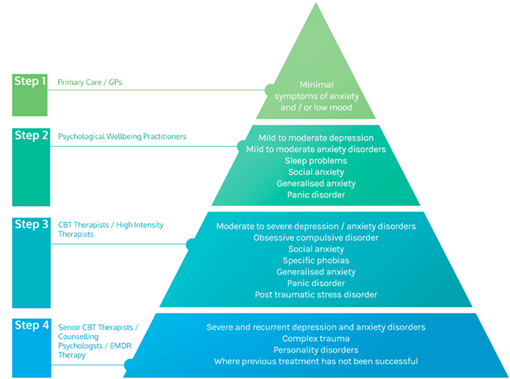
Please note, if you feel you need support from Step 4 Psychotherapy, please contact your GP for a referral to the Mental Health Assessment & Intervention Service (MAIS)
What mental health problems can NHS Plymouth Talking Therapies support me with?
We can help you manage common mental health conditions, including:
- Generalised Anxiety Disorder (GAD)
- Panic attacks and agoraphobia
- Specific phobias (e.g. fear of flying, emetophobia)
- Social anxiety
- Health anxiety
- Obsessive Compulsive Disorder (OCD)
- Post-traumatic stress disorder (PTSD)
- Low self-esteem
- Stress
- Depression (including postnatal depression)
You don’t need a professional referral to access our service, you can self-refer and we’ll carry out an assessment to find the right type of support for you.
What can’t NHS Plymouth Talking Therapies help me with?
Our service is designed for people with mild to moderate mental health difficulties. We are not able to provide:
- A formal diagnosis of mental health conditions
- Assessments or diagnosis for ADHD or autism*
- Medication management or prescribing
- Support for active substance misuse (drugs or alcohol)
- Care for complex or severe mental health difficulties, such as severe personality disorders or eating disorders
- Crisis or emergency support, including suicidal thoughts, self-harm, psychosis, or other urgent psychiatric needs
- Long-term therapy for complex needs that require specialist or hospital-based services
If your needs are better supported elsewhere, we will do our best to help signpost or refer you to the right service.
* If you are waiting for, or suspect you may have, a diagnosis of ADHD or autism, you are still very welcome to access our service. We can support you with common mental health difficulties such as anxiety and depression, but we cannot provide diagnostic assessments or specialist ADHD/autism treatment. the right type of support for you.
How will NHS Plymouth Talking Therapies communicate with me?
Our standard method is Electronic Letters (E-Letters), which you’ll receive by SMS with a secure link to view on your phone/device.
We will also contact you by email, text, or phone to allow you to book, confirm and remind you of appointments.
For our assessment bookings, our booking links have a 10-day expiry period, you will be sent reminders to book your assessment. We will also call you if we can see you have not booked. If you have not booked your assessment within 10 days of the link being sent to you, your referral with our service will be closed.
We can provide:
- Interpreters
- British Sign Language (BSL)
- Makaton support
If you have accessibility needs, please let us know when you make your referral, or call us on 01752 435419 (Mon–Fri, 9am–5pm). If lines are busy, leave a clear voicemail and we’ll get back to you.

NHS Plymouth Talking Therapies is not an emergency service
When struggling, it is not uncommon for people to have difficult thoughts or feelings of hopelessness.
We are not an emergency service, so it is very important that you seek help from the right sources if you are having thoughts of hurting yourself:
First Response Service via NHS 111 (24/7 mental health crisis line – select the mental health option)
Valued Lives 01209 901438 (7 days a week 5pm-midnight)
Samaritans 116 123 (free from mobile or landline)
SHOUT – 24/7 text service – (Text Shout to 85258)
SANE 4pm-10.30pm 365 days a year – 0300 304 7000
Papyrus – for young adults 0800 068 4141
Campaign against living miserably (CALM) for men – 0800 58 58 58
Childline – 0800 1111
If there is a life-threatening situation you need to contact emergency services on 999 or present at the nearest A&E department (Derriford Hospital).
For all non-emergency medical/mental health interventions please contact your GP during normal working hours.
Livewell’s First Response 24/7 crisis line provides advice, support and signposting for people experiencing mental health difficulties. If you feel worried about your mental health or that of a loved one or a friend, you can call the crisis line via NHS 111 (select the mental health option). Click here to find out more.
You can also phone NHS 111 for urgent medical problems who are open 24 hours, 7 days per week.