
We support:
- Over 16s
- Living in Plymouth with a Plymouth GP
- Common Mental Health difficulties such as anxiety & depression
How to access our service:
We encourage you to make a self-referral to our service if you are:
- Experiencing depression anxiety or PTSD.
- 16+ years old.
- Ready to start working on your problems and able to attend regular appointments.
- Registered with a Plymouth GP.
- Not currently receiving support from other mental health services.
Treatments we offer:
- PTSD
- High Intensity CBT
- Low Intensity CBT
- Counselling for Depression
- Employment Support
- LTCs
- Perinatal
- Groups
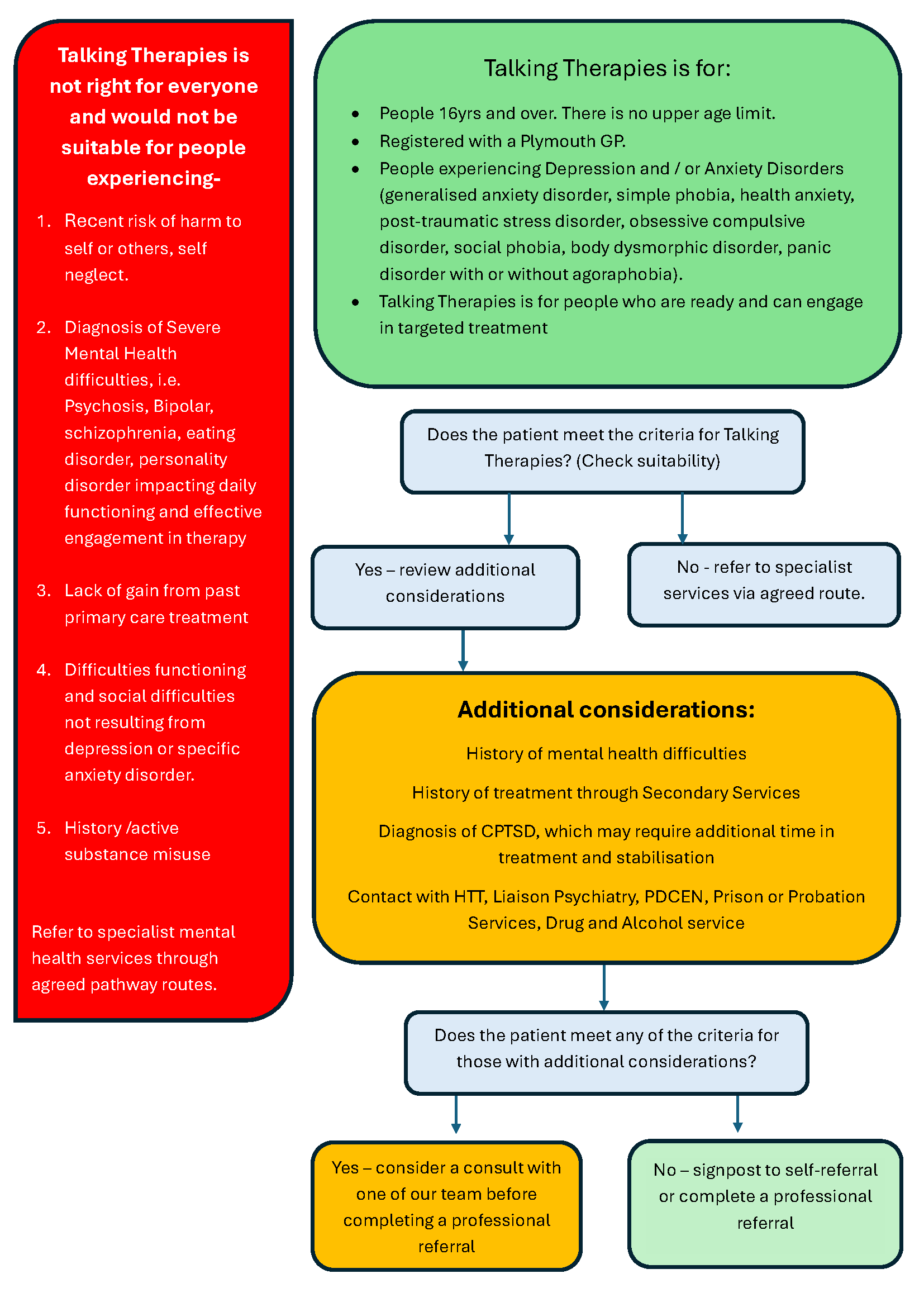
Plymouth Talking Therapies is not suitable for people:
- Who are a high risk to themselves or others, such as current risk of suicide or serious self-harm.
- Using other mental health services, such as the Community Mental Health Team.
- Who have current or severe and enduring mental health needs and as such require specialist services.

Who can make a professional referral to NHS Plymouth Talking Therapies?
- GPs
- Practice Nurses
- Allied Health Professionals
- Adult Social Care Teams
- Other Healthcare Professionals
I am a professional making a referral
If urgent or crisis intervention is required, patients can be directed to contact First Response by calling 111 or attending their nearest Emergency Department.
GPs and professionals can also contact First Response if advice is required by calling the professional line on 01752 434135. GPs can also refer to First Response via e-Referrals marked as urgent.
If you are GP or healthcare professional with a patient that you feel may benefit from our services, you can, with their knowledge and consent, refer them.
We are a Talking Therapies Service that treat people 16years and over, no upper age limit, who are registered with a Plymouth GP.
We treat people experiencing:
- Depression
- Anxiety Disorders
- generalised anxiety disorder
- simple phobia
- health anxiety
- post-traumatic stress disorder
- obsessive compulsive disorder
- social phobia
- panic disorder (with or without agoraphobia)
- body dysmorphic disorder
What we cannot treat and where to refer
If patients are presenting with any of the below, please consider a referral to either the Community Mental Health Service (CMHS) or the Mental Health Assessment & Intervention Service (MAIS). You can do this by using the National E-Referrals System.
- Risk of suicide:
- People with current risk of suicide indicated by either/or
- Suicidal ideation, with evidence of intent and/or plans.
- Recent suicide attempt or self-harm event, within the past 3 months.
- People with current risk of suicide indicated by either/or
- Risk of self-harm:
- Self-harming behaviours that would require medical attention.
- Self-harming behaviours resulting from marked emotional dysregulation as a primary treatment need.
- Risk of harm to others:
- Presenting current risk of harm to others.
- Involvement in safeguarding actions will not exclude if risks are reduced and person well engaged. Those with involvement with probation service will not be excluded if assessed low risk.
- People who have anger problems without signs of anxiety and depression.
- Risk of neglect:
- Current self-neglect significantly impacting on daily life and safety. Please refer to Adult Social Care.
- Risk of harm from others:
- Living in an abusive or unstable home environment, as psychological therapy is unlikely to meet their needs, you will need to consider a safeguarding referral or referral to PDAS.
- People under the age of 16yrs:
- Refer to CAMHS.
- Patients who are not registered with a Plymouth GP:
- Refer to local Talking Therapy service – Find NHS talking therapies for anxiety and depression
- People who have long term psychiatric & emotional disorders. Consider referral to the Community Mental Health Service (CMHS) or the Mental Health Assessment and Intervention Service (MAIS):
- Bipolar disorder.
- psychosis.
- personality disorder having an impact on therapy.
Other complex presentations
We are unable to accept the following:
- Currently receiving care from another specialist mental health services without prior consultation.
- In a current mental health crisis or distress.
- Those with a history of recurrent treatment failure and/or recurrent lack of engagement with treatment services.
- With long-standing problems or severe symptoms or with multiple life problems having an impact on everyday functioning which reduces ability to engage in therapy.
- Those who use alcohol and drugs leading to unstable and chaotic lives. Refer to Harbour.
- Presentations of Eating disorders, consult Eating Disorder Service Plymouth
You can also visit the Devon Formulary & Referral website for more of our criteria, and other Mental Health Services.
By completing the professional referral form you are agreeing that you have read and understood the service criteria, and you believe that the patient will gain from treatment within the Talking Therapies service.
Please Note: GP practices should download the referral form and can submit attached to the E-Referral to Plymouth Talking Therapies. All other healthcare professionals can email the referral form as an attachment.
Please Note: All information required is in the referral form. Missing information will lead to the referral being returned to you.
Please click on the flow chart below to open this in a new tab.
NHS Plymouth Talking Therapies is not an emergency service
When struggling, it is not uncommon for people to have difficult thoughts or feelings of hopelessness.
We are not an emergency service, so it is very important that you seek help from the right sources if you are having thoughts of hurting yourself:
First Response Service via NHS 111 (24/7 mental health crisis line – select the mental health option)
Valued Lives 01209 901438 (7 days a week 5pm-midnight)
Samaritans 116 123 (free from mobile or landline)
SHOUT – 24/7 text service – (Text Shout to 85258)
SANE 4pm-10.30pm 365 days a year – 0300 304 7000
Papyrus – for young adults 0800 068 4141
Campaign against living miserably (CALM) for men – 0800 58 58 58
Childline – 0800 1111
If there is a life-threatening situation you need to contact emergency services on 999 or present at the nearest A&E department (Derriford Hospital).
For all non-emergency medical/mental health interventions please contact your GP during normal working hours.
Livewell’s First Response 24/7 crisis line provides advice, support and signposting for people experiencing mental health difficulties. If you feel worried about your mental health or that of a loved one or a friend, you can call the crisis line via NHS 111 (select the mental health option). Click here to find out more.
You can also phone NHS 111 for urgent medical problems who are open 24 hours, 7 days per week.